
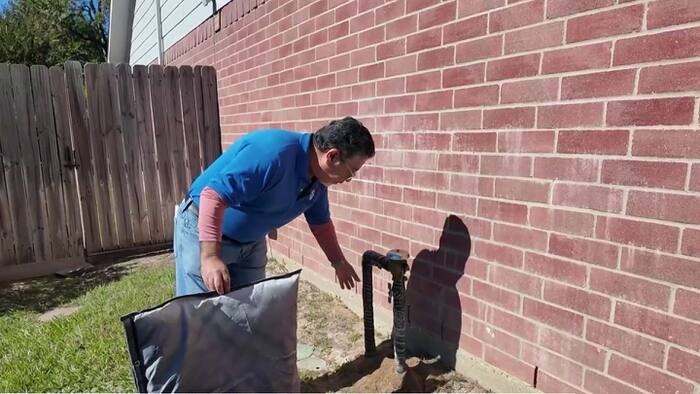
HOUSTON – Edgar Sarrano has lived in Houston for about 30 years, but winter prep wasn’t always on his to-do list.
That changed after he watched friends deal with burst pipes, expensive repairs, and water damage—so bad that some of them had to leave their homes.
“I didn’t used to do this every year, but we learned,” Sarrano said.
So when the deadly February 2021 winter freeze hit Texas, Sarrano had already taken steps to protect his home—and he avoided the costly damage many others experienced.
For the past five or six years, he’s worked with Freddy Salazar, a Houston-based energy and weatherization specialist with Afford Your Electricity Co.
“And since that time we haven’t had any problems at all,” Sarrano said.
KPRC 2 walked through Sarrano’s home with Salazar to show how a little time and money now can help you avoid much bigger problems later.
First stop: a walk around the outside of your house.
Salazar says if you’ve got exposed water pipes, you’ll want to cover them with foam insulation—the kind that can cost just a few dollars at a hardware store.
“Any pipes that you can get to on the outside, they’re going to freeze up and they’re going to bust. They’re going to be costing you a lot more money than just spending a couple of dollars on foam insulation,” Salazar said.
Here’s what you can do:
If a pipe bursts inside your home, would you know how to shut off the water—fast?
Salazar showed KPRC 2 where Sarrano’s main shutoff valve is and says it’s something you should locate and learn before there’s an emergency.
“God forbid something all of a sudden broke in the house. You need to come out here and close this line right here,” Salazar said.
Being able to shut off your water quickly can help prevent major damage.
And during extreme cold, always follow guidance from local officials and your water provider on whether to drip faucets or shut off and drain plumbing.
Sarrano said he learned this one the hard way.
Clogged gutters caused water to overflow and rot wood along his roofline—eventually giving an animal a way into his attic.
“Something that we had to take care of because we had either a raccoon or an opossum. And he made his house there,” Sarrano said.
Salazar says clogged gutters can lead to expensive repairs and can also become an easy entry point for animals looking for warmth.
His advice: clean them out now, then check again mid-to-late December when more leaves have fallen.
And if you can’t reach your gutters safely, consider hiring a professional.
A simple way to see if you’re losing heat: close your front door and look closely around it.
“When you lock your door, make sure you don’t see any light around it,” Salazar said.
If you can see daylight, that’s a sign air is escaping.
Check weatherstripping around all exterior doors and windows, and replace it where needed. Use caulk to seal stationary cracks and gaps.
Salazar said some replacement weatherstrips cost about $3 to $5 each.
“It’s actually very inexpensive. It’s just that it’s time consuming,” he said.
And he points out it’s not just a winter benefit—sealing leaks can also help lower energy bills during Houston’s hot summers.
In Sarrano’s attic, Salazar pointed out water lines already covered with foam insulation.
He recommends:
“You have to treat this as an exterior door, just like the front door,” he said.
And once foam pipe insulation is installed, it can stay in place year-round.
A lot of winter prep protects your house and your wallet.
This step can protect your life.
In the attic, Salazar pointed to the HVAC system and talked about checking a part called the heat exchanger.
If a gas furnace has a cracked heat exchanger, carbon monoxide can leak into your home.
Carbon monoxide is colorless, odorless, and potentially deadly.
Sarrano has his HVAC system professionally inspected every year—something Salazar strongly recommends.
“This is important for the winter. And you need to have it checked,” Salazar said.
To protect your family:
Symptoms of carbon monoxide poisoning can include headaches, dizziness, nausea, weakness, and confusion.
If your alarm sounds or you suspect carbon monoxide exposure, get everyone outside immediately and call 911.
Do not reenter until emergency responders say it’s safe.
Brian Murray, with Harris County’s Office of Homeland Security and Emergency Management, says families should keep seven to 10 days’ worth of emergency supplies on hand year-round.
“I don’t care if it’s hurricane season. I don’t care if it’s winter weather season. You need to have some sort of a disaster kit,” Murray said.
Those supplies should include:
To make it more affordable, Murray suggests grabbing a few extra items each time you go to the store.
Nearly six years after the February 2021 winter freeze, Harris County emergency management officials say they’re still refining their response plans.
“We’ve had plans in place for multiple years. We refine them after every event,” Murray said.
Since 2021, Murray says the county has worked to better identify where people experiencing homelessness are staying so emergency responders can reach them during severe weather.
He said plans are also in place to open warming centers and arrange transportation if conditions warrant.
Residents are encouraged to enable emergency alerts on their phones and sign up for county notifications at ReadyHarris.org.
If winterizing your home just isn’t in the budget, there are programs that offer free improvements for qualifying households in the Houston area.
Salazar’s company, Afford Your Electricity Co., does weatherization work through CenterPoint Energy’s program.
He said households may qualify based on income, where they live, or whether someone in the home receives government assistance like SNAP, Medicaid, or the Children’s Health Insurance Program.
“Get on the waitlist, because we do this year round,” Salazar said.
CenterPoint Energy – Agencies in Action: Offers free energy assessments, insulation, weatherstripping, air sealing and certain HVAC improvements. Renters may qualify with their landlord’s permission. Homes generally must be at least 16 years old and meet certain safety requirements.
BakerRipley – Weatherization Assistance Program: Provides free insulation, air sealing and other energy efficiency improvements to qualifying households.
Texas Department of Housing and Community Affairs: Provides federally funded weatherization assistance through local agencies, including insulation, duct repairs and certain heating and cooling system improvements.
Coalition for Environment, Equity, and Resilience (CEER): Helps Houston residents access free weatherization services and provides application assistance.
Residents can also call 211 for help finding local assistance.
Eligibility requirements, available services, and wait times vary by program.
Sarrano says starting in early fall helps—because it gives you time to gather supplies, schedule appointments, and make repairs before demand ramps up.
But even if you’re behind, he says don’t wait for the next freeze.
For Sarrano, protecting the home he’s lived in for about 26 years is worth it.
“It will be minimal compared to what you will pay if you didn’t do this,” he said.


